+86-21-20919968


Carbonless paper, also known as carbonless copy paper or pressure-sensitive recording paper, is a type of paper that can achieve copy function without using carbon powder or copy paper under pressure. It is a special type of paper widely used in modern commercial or office applications. The core principle is to attach a special German chemical coating to the back or front of the paper, commonly known as the "CB side" or "CF side". Through the pressure of writing or printing, the microcapsules are broken, and the colorless dye in them reacts chemically with the color developer, thus revealing the handwriting. The size is mainly divided into two categories: flat and roll, with a conventional weight of 45-80gsm.
Raw materials and processes for carbonless paper
The manufacturing of carbonless paper is a sophisticated technology, and next we will mainly introduce the raw material composition of each type of paper.
The base paper requires high strength, good surface smoothness, moderate ink absorption, and uniform thickness. This type of paper is usually made from high-quality wood pulp or straw pulp paper. Its function is to serve as a carrier for microcapsule and colorant coating.
For the coloring layer, also known as CB coating, the first one is colorless dye, which is the "ink" for color reproduction and is itself colorless. The most commonly used one is crystal violet lactone, which appears blue when exposed to acid, and other dyes such as benzoyl colorless methylene blue appear black. Then there are microcapsules, which are made of gelatin, arabic gum, or synthetic polymers that encapsulate a colorless dye solution. Under pressure, the capsules will rupture. A solvent is a colorless dye dissolved in it, usually a high boiling alkylbenzene solvent, while an adhesive firmly adheres microcapsules to the back of the base paper.
On the color developing layer, also known as the CF coating, there is a color developing agent, which is a "chemical reactor" and a solid acid. Traditionally, clay is used, while environmentally friendly products often use phenolic resins; Adhesives are used to adhere color developing agents to the front of the base paper, while fillers such as calcium carbonate are used to adjust the porosity and color development performance of the coating.
Finally, there is the color developing layer, also known as CFB coating, which is used for intermediate paper. The front side is CF coating and the back side is CB coating, and its raw material is a combination of the above two coatings.
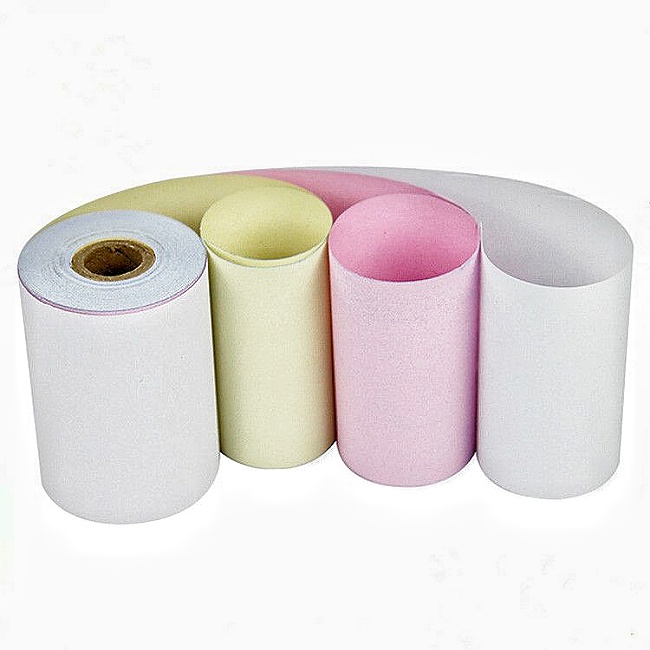
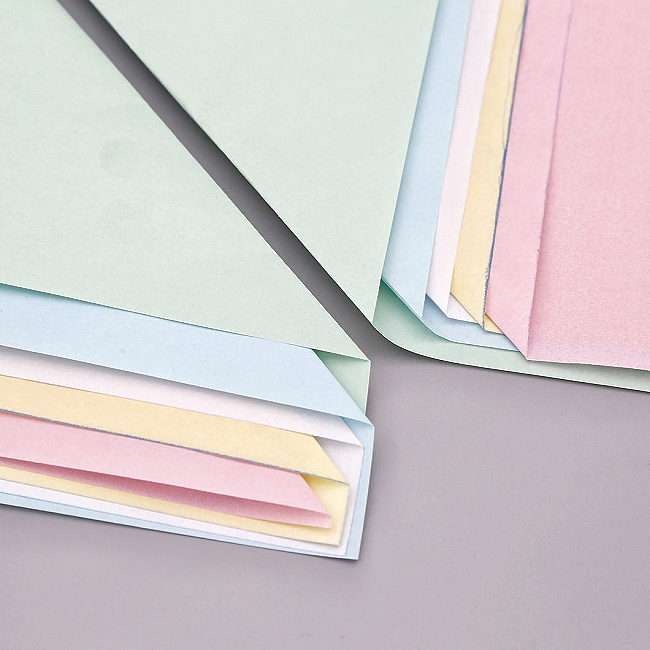
Carbonless paper is usually classified based on its coating and number of contacts in different colors for easy identification and archiving by users. The back of CB paper is coated with a microcapsule layer containing colorless dye, while the front is usually white and used for writing or printing; Zhongzhi is CFB paper, which is coated with a color developer on the front and microcapsules on the back. It is usually colored, such as pink, green, yellow, etc. It can be used as a copy of the previous page or copied to the next page; The bottom paper is CF paper, which is only coated with color developer on the front, usually white or colored. As the last copy, it only accepts the copied content and does not copy downwards. There is no absolute standard for color selection, but there are already some conventions in the industry, such as the first color being white and the last color being yellow.
Characteristics of carbonless paper
advantage
Easy to clean: No need to insert traditional blue or black carbon paper, avoiding dirtying hands and clothing, easy to use.
Efficient and clear: The speed of copying is fast, and multiple copies can be generated in one writing or printing.
Copy consistency: All copies display consistent information to avoid errors that may be caused by hand copying.
Strong anti-counterfeiting: Fluorescent fibers, watermarks, and other anti marking can be added to the page to improve the security of the bill.
Environmentally friendly option: This paper does not require the addition of carbon powder, and some carbonless papers use environmentally friendly color developers, reducing environmental burden.
shortcoming
Afraid of light and heat: Long term exposure to sunlight or high temperatures may cause handwriting to fade, affecting long-term preservation.
Afraid of chemicals: Contact with organic solvents such as alcohol and plasticizers may cause handwriting to become blurry or disappear.
High cost: higher than the cost of ordinary paper or traditional copy paper
Paper is brittle: Due to the coating on the surface, the paper feels brittle and is prone to cracking when folded.
The use of carbonless paper
Carbonless paper is mainly suitable for multiple copies of forms and various bills and documents, including invoices, receipts, customs declarations, etc; Some business documents, such as contracts, orders, customs declarations, etc; Or for licenses, application forms, tax receipts, etc. required for government services; There are also delivery notes, waybills, etc. used for logistics transportation.
In general, as a special type of paper, carbonless paper has the characteristics of environmental protection and high efficiency. When choosing, we should choose the appropriate weight based on the number of pairs and printing equipment. The more pairs, the lower the importance of the chosen weight. Therefore, we need to combine multiple standards to select the most suitable combination of carbonless paper.